


Summary:
Equities rallied broadly this week, with the S&P 500 up +3.7%, the Nasdaq gaining +4.3%, and Bitcoin surging +7.3%, while crude oil was the clear outlier, collapsing -11.1% after gapping lower on April 7th. The 10-year Treasury yield was essentially flat at 4.29%, down just 1bp on the week. March payrolls surprised to the upside at +178k versus +65k, but cooling wage growth and a sharp drop in the ISM Services employment component to 45.2 may suggest softening labor demand beneath the headline strength. AI-related names drove much of the equity momentum, highlighted by Broadcom’s custom chip deal with Google, Amazon’s $12 billion Mississippi investment, and Meta’s rally following the launch of Muse Spark. Rate cut expectations continued to fade, with markets now pricing only a 32% chance of a Fed cut by year-end, a notable divergence from the Fed’s own projection of one cut in 2026.
10-Year Treasury Yield
- Current Rate: 4.29% (as of April 9, 2026)
- Week-to-date Movement: -1bp (from 4.30% on April 2, 2026)
Major U.S. Equity Indices Performance
- S&P 500: 6,582.69 → 6,824.66 (+3.68% WTD)
- DJIA: 46,504.67 → 48,185.80 (+3.61% WTD)
- Nasdaq Composite: 21,879.18 → 22,822.42 (+4.31% WTD)
Notable Market Events
- Macroeconomic Data: March payrolls came in well above expectations at +178k versus +65k, but the strength may be tempered by -7k in net downward revisions and cooling wage growth (+0.2% MoM vs. +0.3% expected), potentially signaling that the labor market is adding jobs while losing pricing power, which could read as a disinflationary development for the Fed. The ISM Services employment component fell sharply to 45.2 from 51.8, suggesting the services sector may be approaching a hiring slowdown even as input costs climbed (prices paid jumped to 70.7), a combination that could point toward stagflationary dynamics and complicate the rate path. February core PCE held at +0.4% MoM with the year-over-year rate at 3.0%, still meaningfully above the Fed’s 2% target and implying limited flexibility for near-term cuts. The Q4 GDP third estimate was revised down to +0.5% annualized, with personal consumption trimmed to +1.9%, which appears to reinforce a narrative of softening momentum beneath the surface. Personal income’s surprise decline of -0.1% against a +0.3% forecast may flag early signs of consumer fatigue heading into Q2, even as spending held up at +0.5%, a gap that would likely require continued savings drawdowns or credit expansion to persist, neither of which tends to be sustainable over longer periods.
- Economic Policy: Geopolitical tensions showed signs of easing after the U.S. and Iran agreed to a two-week ceasefire. However, as traders continue to navigate elevated volatility across global markets, rate cut expectations have been pared back significantly — with markets now pricing just a 32% chance of a Fed cut by year-end, despite the Federal Reserve’s own projections pointing to one cut in 2026. The divergence between market pricing and Fed guidance underscores the difficult position policymakers find themselves in, as macro uncertainty continues to cloud the path forward for monetary policy.
- Business: CoreWeave (NYSE: CRWV) advanced +4.5% on Thursday after the company struck a $21 billion deal to supply computing power to Meta (NYSE: META) through 2032. Amazon (NYSE: AMZN) jumped over +5% after announcing a fresh $12 billion investment in Mississippi to accelerate its AI and cloud expansion. Broadcom (NYSE: AVGO) soared over +6% after signing a five-year deal with Google (NYSE: GOOG) to develop custom AI chips, known as Tensor Processing Units (TPUs). Meta (NYSE: META) shares rallied over +6.5% on Wednesday after unveiling Muse Spark — the first model from its newly formed Meta Superintelligence Labs and now the most powerful model powering Meta AI. On the other hand, cybersecurity names came under pressure, with CrowdStrike (NYSE: CRWD) and Palo Alto Networks (NYSE: PANW) selling off following Anthropic’s debut of Project Glasswing, the AI startup’s new defense-focused cybersecurity initiative.
- Markets: Risk assets rebounded sharply this week while crude oil cratered. Bitcoin led the board at +7.3% and silver advancing +3.6%. Gold was a nonfactor, inching up just +0.2%. The dollar slipped -1.2% on the week. The standout move was in crude, which collapsed -11.1%, gapping lower on April 7th and briefly touching -15% before staging a modest recovery.
Stock Sector Performance
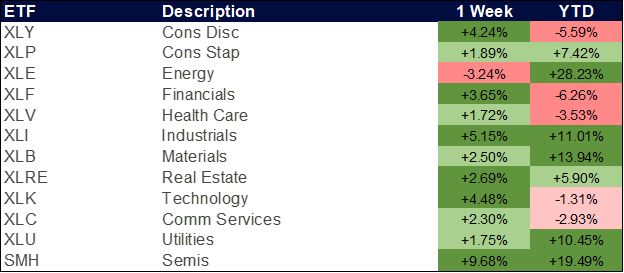
All performance figures and market events are sourced from Bloomberg as of market close 4/09/2026, using the prior Friday’s market open as the start date.
Disclosures
OpenArc Corporate Advisory, LLC, (“OpenArc”) is a registered investment adviser with the Securities and Exchange Commission. This material is presented for informational purposes only and should not be construed as an attempt to sell or solicit any products or services of OpenArc nor should it be construed as legal, accounting, tax or other professional advice. Past performance of model performance shown is no guarantee of future results. The model portfolio performance does not reflect actual trading or any advisory, management, or transaction fees, all of which could result in substantially lower results. This does not reflect the impact that material economic and market factors may have had on decision making. You cannot invest directly in an index.
This investment strategy is based on a model portfolio developed by Dynasty Wealth Management, LLC (“Model provider”), a registered investment adviser with the Securities and Exchange Commission. OpenArc retains full discretion over the implementation, customization, and management of client accounts using this model. The Model provider does not manage client accounts, does not provide individualized investment advice, and is not responsible for investment decisions, performance outcomes, or suitability determinations. The Model provider receives compensation from the underlying investments. Outsourcing costs range from 2 – 4 bps (program fee) and can be discounted based on assets under management. Outsourcing includes investment management, trading, billing, and communications. This fee will be absorbed by OpenArc.
Performance data does not reflect the deduction of advisory fees or any other expenses clients may incur in the management of their advisory account, which will result in a reduction of client’s returns. It is the responsibility of OpenArc to disclose the advisory fees charged and how it affects the returns shown in this document. Additionally, the effect of income taxes is not shown. The performance reflects reinvestment of dividends and interest, as applicable.
This material does not take into consideration an investor’s specific investment objectives or risk tolerance. Performance analysis is based on information provided by Morningstar, or other third parties. The information contained in this presentation has been gathered from sources we believe to be reliable, but we do not guarantee the accuracy or completeness of such information, and we assume no liability for damages resulting from or arising out of the use of such information.
Historical performance results for investment indices and/or product benchmarks have been provided for general comparison purposes only, and do not include the charges that might be incurred in an actual portfolio, such as transaction and/or custodial charges, investment management fees, or other fees applicable to the account, all of which could result in substantially lower results. It should not be assumed that your account holdings correspond directly to any comparative indices.
The information presented does not reflect the impact of taxes on non-qualified accounts. Any tax considerations do not constitute tax advice and are not intended to be used to avoid federal, state or local income tax, or related tax liability. We do not provide legal, accounting or tax advice. You are encouraged to discuss the tax and legal implications of any transactions contemplated with a professional legal, accounting or tax advisor.