


Summary:
Markets were broadly weaker on the week as Treasury yields continued to move higher, with the 10‑year rising +11bps to 4.25%, while U.S. equities declined amid mounting macro and geopolitical crosscurrents. The S&P 500 fell ‑0.75% WTD and the Dow Jones Industrial Average declined ‑1.61%, while the Nasdaq Composite proved relatively resilient with a smaller ‑0.23% pullback. Incoming economic data increasingly pointed to a deceleration in growth, as February labor reports showed a notable contraction in payrolls along with an uptick in the unemployment rate to 4.4%, while inflation continued to cool gradually with headline CPI easing to 2.4% year over year. Policy expectations grew more cautious as surging crude prices tied to escalating Middle East tensions complicated the Fed’s inflation outlook, prompting markets to price out near‑term rate cuts ahead of next week’s FOMC meeting. Commodity performance reflected heightened geopolitical risk, with the U.S. dollar strengthening, Bitcoin stabilizing near flat at roughly +1%, gold modestly lower, and WTI crude standing out sharply with a +22.8% surge, supporting energy equities even as most equity sectors traded lower for the week.
10-Year Treasury Yield
- Current Rate: 4.25% (as of March 12, 2026)
- Week-to-date Movement: +11bps (from 4.14% on March 6, 2026)
Major U.S. Equity Indices Performance
- S&P 500: 6,740.02 → 6,689.49 (-0.75% WTD)
- DJIA: 47,501.55 → 46,737.11 (-1.61% WTD)
- Nasdaq Composite: 22,387.68 → 22,337.25 (-0.23% WTD)
Notable Market Events
- Macroeconomic Data: Incoming U.S. data over the past week point to a clearer deceleration in growth, though broader conditions remain stable. February labor data weakened meaningfully, with nonfarm payrolls declining by -92k and private payrolls down -86k, signaling cooling hiring momentum, with the unemployment rate rising to 4.4% and claims remaining contained near 213k. Inflation continued to ease at a gradual pace, with February CPI rising +0.3 percent month over month, core CPI up +0.2 percent, and year over year measures moderating to 2.4 percent headline and 2.5 percent core. Consumer and housing indicators were mixed but showed early signs of stabilization, as retail sales posted modest gains and mortgage applications rebounded sharply, suggesting demand may be responding to lower rates despite softer sentiment.
- Economic Policy: Escalating geopolitical tensions in the Middle East have clouded the macro backdrop, with rising oil prices posing a fresh challenge to the Fed’s inflation objectives. As crude surges past $100 per barrel, traders have begun pricing out year-end rate cuts, leaving the timing of the first reduction increasingly uncertain. The Fed convenes on the 18th and is widely expected to hold rates steady, with markets closely watching for any commentary on the path forward.
- Business: Oracle (NYSE: ORCL) surged +9% on Wednesday after reporting a +44% year-over-year increase in cloud revenue and reassuring analysts that the company has no plans to raise additional debt in 2026 beyond what was previously announced. Airlines (NYSE: JETS) retreated over the week as rising oil prices and headwinds from restricted international travel weighed on the sector. Dick’s Sporting Goods (NYSE: DKS) edged up +1% following better-than-expected holiday season earnings, though weak profit guidance tempered enthusiasm as the pending Foot Locker acquisition pressured its bottom line. Deutsche Bank (NYSE: DB) tumbled -6% on Thursday after disclosing a $30 billion exposure to private credit — an asset class facing mounting pressure from fund redemptions, heightened scrutiny of underwriting standards, and the disruptive impact of AI on software-sector borrowers.
- Markets: Commodity markets were increasingly driven by geopolitical risk, with price action reflecting a rapid repricing of supply security rather than broad based macro trends. Bitcoin stabilized following recent weakness, trading roughly flat to modestly higher at around +1% on a normalized basis, while the U.S. dollar strengthened, with DXY up approximately +0.4%. Precious metals failed to sustain early strength, with gold drifting lower by roughly ‑0.2% and silver underperforming at about +2.9%, suggesting that safe haven demand softened despite escalating headlines tied to the conflict involving Iran. Oil remained the clear outlier, with WTI elevated by roughly +22.8% as markets continued to price in heightened supply risk, reinforcing pressure on oil import dependent economies while supporting energy linked assets.
Stock Sector Performance
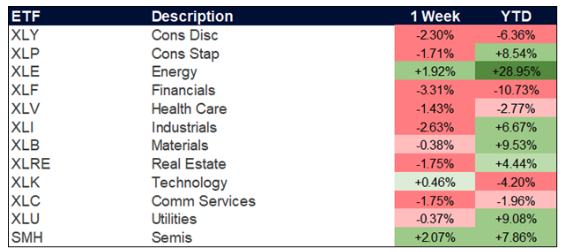
All performance figures and market events are sourced from Bloomberg as of market close 3/12/2026, using the prior Friday’s market open as the start date.
Disclosures
OpenArc Corporate Advisory, LLC, (“OpenArc”) is a registered investment adviser with the Securities and Exchange Commission. This material is presented for informational purposes only and should not be construed as an attempt to sell or solicit any products or services of OpenArc nor should it be construed as legal, accounting, tax or other professional advice. Past performance of model performance shown is no guarantee of future results. The model portfolio performance does not reflect actual trading or any advisory, management, or transaction fees, all of which could result in substantially lower results. This does not reflect the impact that material economic and market factors may have had on decision making. You cannot invest directly in an index.
This investment strategy is based on a model portfolio developed by Dynasty Wealth Management, LLC (“Model provider”), a registered investment adviser with the Securities and Exchange Commission. OpenArc retains full discretion over the implementation, customization, and management of client accounts using this model. The Model provider does not manage client accounts, does not provide individualized investment advice, and is not responsible for investment decisions, performance outcomes, or suitability determinations. The Model provider receives compensation from the underlying investments. Outsourcing costs range from 2 – 4 bps (program fee) and can be discounted based on assets under management. Outsourcing includes investment management, trading, billing, and communications. This fee will be absorbed by OpenArc.
Performance data does not reflect the deduction of advisory fees or any other expenses clients may incur in the management of their advisory account, which will result in a reduction of client’s returns. It is the responsibility of OpenArc to disclose the advisory fees charged and how it affects the returns shown in this document. Additionally, the effect of income taxes is not shown. The performance reflects reinvestment of dividends and interest, as applicable.
This material does not take into consideration an investor’s specific investment objectives or risk tolerance. Performance analysis is based on information provided by Morningstar, or other third parties. The information contained in this presentation has been gathered from sources we believe to be reliable, but we do not guarantee the accuracy or completeness of such information, and we assume no liability for damages resulting from or arising out of the use of such information.
Historical performance results for investment indices and/or product benchmarks have been provided for general comparison purposes only, and do not include the charges that might be incurred in an actual portfolio, such as transaction and/or custodial charges, investment management fees, or other fees applicable to the account, all of which could result in substantially lower results. It should not be assumed that your account holdings correspond directly to any comparative indices.
The information presented does not reflect the impact of taxes on non-qualified accounts. Any tax considerations do not constitute tax advice and are not intended to be used to avoid federal, state or local income tax, or related tax liability. We do not provide legal, accounting or tax advice. You are encouraged to discuss the tax and legal implications of any transactions contemplated with a professional legal, accounting or tax advisor.