


January Market Brief
We maintain a tactical risk-on stance in our asset allocation, reflecting our confidence in the current market’s return potential.
By: CIO Office
CIO SNAPSHOT
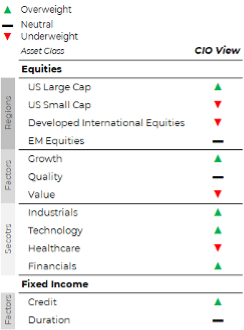
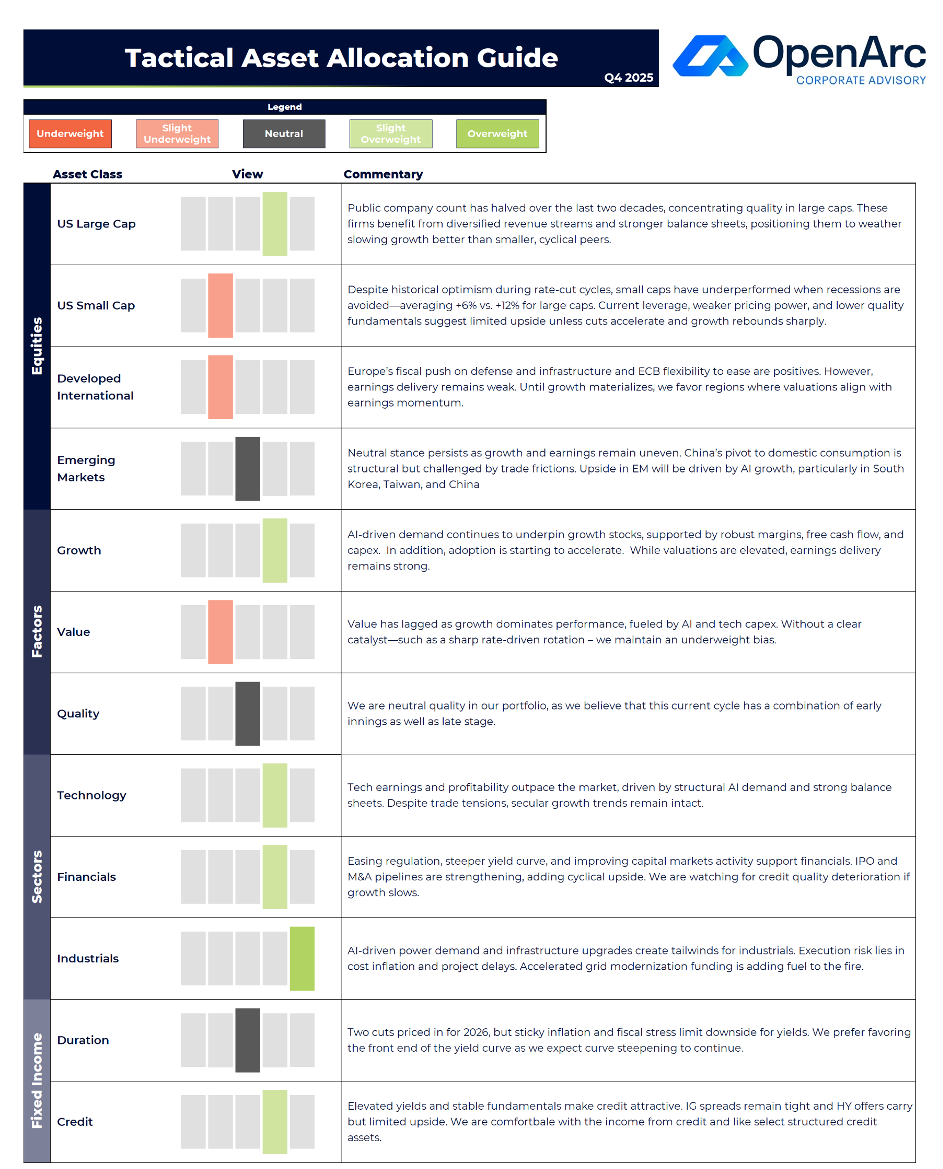
We maintain a tactical risk-on stance in our asset allocation, reflecting our confidence in the current market’s return potential. We remain overweight equities, and recently increased exposure to U.S. markets funded from International Developed, as we believe robust U.S. earnings growth continues to underpin domestic equity performance. Within equities, we are responsibly bullish on the AI supercycle, with targeted allocations to technology and power infrastructure, and are optimistic on financials and defense, supported by lighter regulation and elevated fiscal spending, respectively. In fixed income, we hold a neutral position in duration to manage rate sensitivity, while emphasizing higher-yielding opportunities that deliver compelling income generation in today’s environment.
Source: Dynasty Financial Partners, Morningstar, Bloomberg, Strategas, BCA, Goldman Sachs Research, YCharts, as of 12/31/2025
MACRO
Growth: The government resumed most economic data releases, providing more visibility into the broader economy. The unemployment rate increased by +0.1% to 4.6%, and +64,000 jobs were added to the U.S. economy during the month of November, according to the December 16th nonfarm payrolls report. This came in above the consensus estimate of +50,000, a welcome change after missing expectations for October. Unemployment registered 4.4% in the December report, and despite month‑to‑month noise, the broader trend remains upward, with underemployment consistently moving higher.
Inflation: November’s CPI data, released on December 18th, came in below expectations at +2.7% (versus expectations of +3.1%). Core inflation also came in under expectations, with Core CPI coming in at +2.6% vs expectations of +3.0%. Shelter inflation continues to march lower, notching the lowest mark (+1.81%) since 2021.
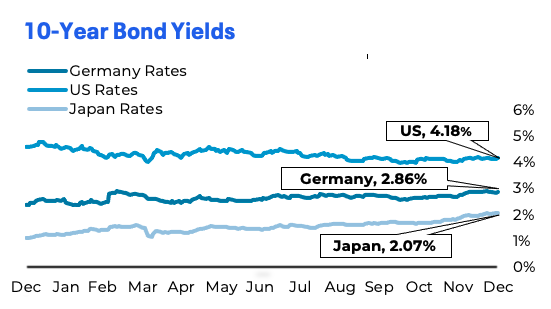
Monetary Policy: The Fed delivered another 25 bp rate cut at the December meeting, despite the probability falling toward 30% in late November. December FOMC takeaways were also more balanced and less hawkish than expected, with help from the Treasury bill purchase announcement ($40B/month), firmer growth and lower inflation forecasts for 2026, Powell’s comments on the labor market and productivity, and the median longer-run dot still at 3.0%.
MARKET
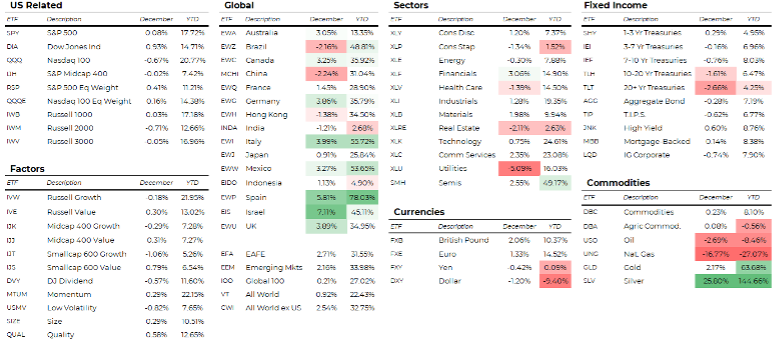
Equities: Markets were split in December as international markets finished 2025 the strongest. International developed equities led the way, up +2.7% for the month, as the S&P 500 ended virtually flat. The Russell 2000 posted the worst December of all major indices, down -0.7%. Sector performance was also split for the month, as Financials led, advancing +3.1%. Communication Services, Materials, and Technology were all positive in December. Utilities were the most challenged during the month, down -5.1%, followed by Real Estate, which was down -2.1%.
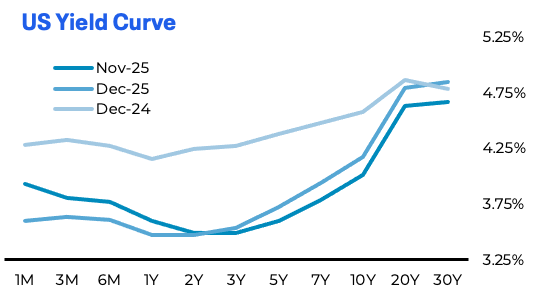
Bonds: Fixed income markets navigated a stable but shifting macro backdrop in December, as services activity strengthened while manufacturing remained in contraction. The yield curve steepened modestly as front‑end rates declined, and sector performance within the Bloomberg U.S. Aggregate Index was led by Agency MBS, with CMBS and ABS also generating positive excess returns. Credit markets experienced modest spread widening amid heavy high‑quality issuance late in the year, contributing to flat investment‑grade performance and notable dispersion across rating tiers and maturities.
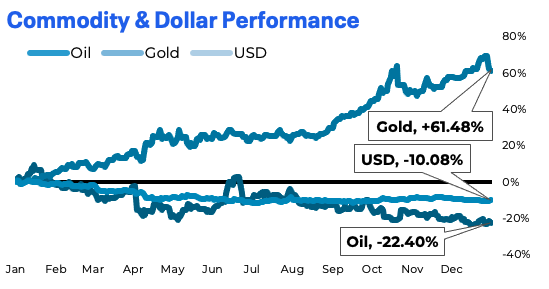
Currencies: Currency markets were once again shepherded by Fed signals and economic data. The Fed’s decision to cut rates and keep the door open for more cuts early in 2026 pushed the dollar down during the month. In addition, the resumption of official economic data releases, which revealed cooling CPI prints, became another headwind for the dollar. European FX held firmer as a softer dollar and stronger international equity performance supported Euro markets. Asian FX was more uneven, as the yen continues to see pressure while other regional currencies moved with tech sentiment and shifting global risk appetite.
Commodities: Commodities saw wide dispersion, with Gold rising +2.2% and Silver gaining a blistering +25.8% as investors continued to pile into precious metals amidst regional conflicts. Oil continued to trend lower, losing -2.7% on the month as demand continues to fall and supply remains relatively elevated.
Source: Dynasty Financial Partners, Morningstar, Bloomberg, Strategas, BCA, Goldman Sachs Research, YCharts, as of 12/31/2025
International Beat Domestic in 2025
The S&P 500 ended 2025 with a strong total return of over +17%. Even so, its performance was overshadowed by the MSCI EAFE and MSCI Emerging Markets indices, which returned +31.55% and +33.98%, respectively. The weak dollar, especially in the first half of the year, helped drive incremental performance across international markets.

Source: Dynasty Financial Partners, Morningstar, Bloomberg, Strategas, BCA, Goldman Sachs Research, YCharts, as of 12/31/2025
CIO Spotlight: The Equal Weight Strikes Back– the 2026 tax refund wave
Market Breadth is Expanding
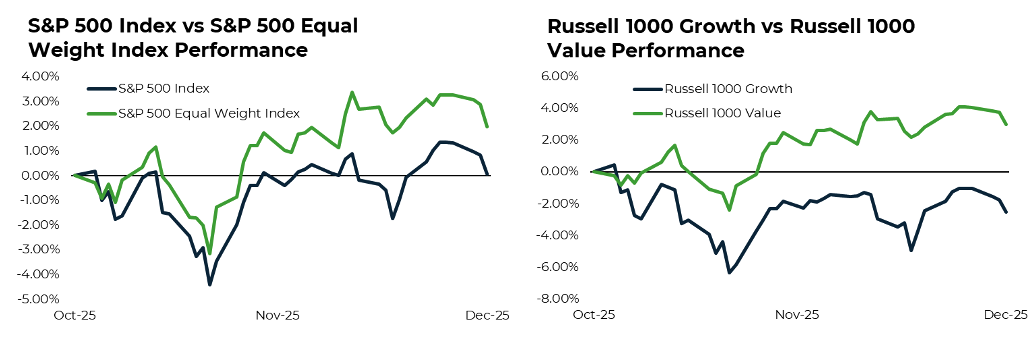
The last two months delivered a notable shift beneath the surface of equity markets, as leadership broadened beyond the mega‑cap growth names that have dominated since early 2023. Equal‑weight and value indices meaningfully outperformed their cap‑weighted and growth counterparts into year‑end, reflecting a market recalibration following heightened volatility around AI‑linked names and the late‑year selloff tied to concerns about high spending and delayed returns on AI investment. Our internal research reinforces this trend: equal‑weight valuations remain more reasonable than cap‑weight indices, with significant room for catch‑up after a prolonged period of concentration at the top of the S&P 500.
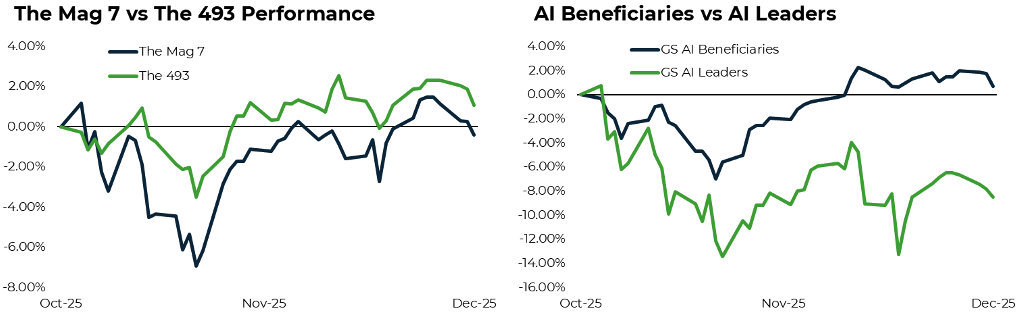
From our perspective, this developing shift is less a reversal of the AI narrative and more an evolution of it. As we highlighted in our recent 1Q 2026 Market Outlook, the first phase of the AI cycle rewarded infrastructure and hyperscaler beneficiaries. However, we think the next phase should increasingly favor companies poised to gain from applied AI, productivity improvements, and downstream adoption. As the earnings gap between mega‑caps and the broader market narrows, and AI leaders keep benefiting from the ongoing AI boom, conditions appear favorable for further market broadening in 2026.
Bottom Line
We expect breadth to expand further as performance transitions from early AI “builders” to the wider ecosystem of corporate adopters. For investors, this environment should reward balance – as well as active management – to identify the winners and losers in the next phase of AI‑enabled growth. In our view, a more distributed market leadership landscape is not only healthy but overdue, and it creates compelling opportunities heading into the new year.
Source: Dynasty Financial Partners, Morningstar, Bloomberg, Strategas, BCA, Goldman Sachs Research, YCharts, as of 12/31/2025
DISCLOSURES
OpenArc Corporate Advisory, LLC, (“OpenArc”) is a registered investment adviser with the Securities and Exchange Commission. This material is presented for informational purposes only and should not be construed as an attempt to sell or solicit any products or services of OpenArc nor should it be construed as legal, accounting, tax or other professional advice. Past performance of model performance shown is no guarantee of future results. The model portfolio performance does not reflect actual trading or any advisory, management, or transaction fees, all of which could result in substantially lower results. This does not reflect the impact that material economic and market factors may have had on decision making. You cannot invest directly in an index.
This investment strategy is based on a model portfolio developed by Dynasty Wealth Management, LLC (“Model provider”), a registered investment adviser with the Securities and Exchange Commission. OpenArc retains full discretion over the implementation, customization, and management of client accounts using this model. The Model provider does not manage client accounts, does not provide individualized investment advice, and is not responsible for investment decisions, performance outcomes, or suitability determinations. The Model provider receives compensation from the underlying investments. Outsourcing costs range from 2 – 4 bps (program fee) and can be discounted based on assets under management. Outsourcing includes investment management, trading, billing, and communications. This fee will be absorbed by OpenArc.
Performance data does not reflect the deduction of advisory fees or any other expenses clients may incur in the management of their advisory account, which will result in a reduction of client’s returns. It is the responsibility of OpenArc to disclose the advisory fees charged and how it affects the returns shown in this document. Additionally, the effect of income taxes is not shown. The performance reflects reinvestment of dividends and interest, as applicable.
This material does not take into consideration an investor’s specific investment objectives or risk tolerance. Performance analysis is based on information provided by Morningstar, or other third parties. The information contained in this presentation has been gathered from sources we believe to be reliable, but we do not guarantee the accuracy or completeness of such information, and we assume no liability for damages resulting from or arising out of the use of such information.
Historical performance results for investment indices and/or product benchmarks have been provided for general comparison purposes only, and do not include the charges that might be incurred in an actual portfolio, such as transaction and/or custodial charges, investment management fees, or other fees applicable to the account, all of which could result in substantially lower results. It should not be assumed that your account holdings correspond directly to any comparative indices.
The information presented does not reflect the impact of taxes on non-qualified accounts. Any tax considerations do not constitute tax advice and are not intended to be used to avoid federal, state or local income tax, or related tax liability. We do not provide legal, accounting or tax advice. You are encouraged to discuss the tax and legal implications of any transactions contemplated with a professional legal, accounting or tax advisor.